By: Jeff Hirz
If you are comparing agencies to manage your paid search or Google Ads campaigns, separate the two costs first: what you pay the ad platform for clicks and what you pay the agency to manage the account.
The first number is your media budget. The second is the management fee. A good PPC management fee should buy more than someone checking a dashboard once a month. It should buy strategy, tracking cleanup, campaign structure, query control, testing, reporting, and the judgment to know when more spend helps and when it only makes waste more expensive.
This guide breaks down current PPC management pricing models, what changes the cost, what the fee should include, and how to judge a quote against ROI instead of judging it by price alone.
PPC Management Pricing: The Short Answer
Most PPC management pricing falls into a few broad planning ranges in 2026:
| Monthly ad spend | Typical monthly management fee | Common fit |
|---|---|---|
| $1,000 to $5,000 | $500 to $2,000 | Small local campaign, single-channel account, limited scope |
| $5,000 to $25,000 | $1,500 to $5,000 | Small to mid-market Google Ads account with active optimization |
| $25,000 to $100,000 | $4,000 to $12,000 | Scaling lead-generation, ecommerce, Shopping, or multi-campaign account |
| $100,000+ | $10,000 to $25,000+ | Enterprise, multi-channel, complex tracking, feed, CRO, or reporting needs |
Percentage-of-spend models commonly land around 10% to 20% of monthly media spend, often with a minimum management fee. Many agencies also use a hybrid model: a fixed base fee plus a smaller percentage of spend above a certain budget.
These are planning ranges, not quotes. A simple local campaign can cost less to manage than a lower-spend account with broken tracking, messy landing pages, and a complex sales cycle. A $20,000 account with clean structure and one goal may need less management than a $10,000 account split across Search, Shopping, Performance Max, retargeting, call tracking, and offline lead imports.
Why PPC Pricing Has Two Separate Costs
PPC cost has two parts:
- Ad spend: the money paid to Google Ads, Microsoft Ads, Meta, LinkedIn, Amazon, or another platform.
- Management fee: the money paid to the agency, consultant, or in-house specialist running the strategy and optimization.
If your Google Ads budget is $15,000 per month and the agency charges $3,000 per month to manage it, your total monthly PPC investment is $18,000 before any one-time setup, landing page, feed, or analytics work.
That split matters because ad spend and management fee do different jobs. Ad spend buys traffic. Management turns that traffic into a controlled business system: which searches you enter, how much you bid, which conversion signals Google learns from, what landing page receives the click, what gets excluded, and what the report tells you to do next.
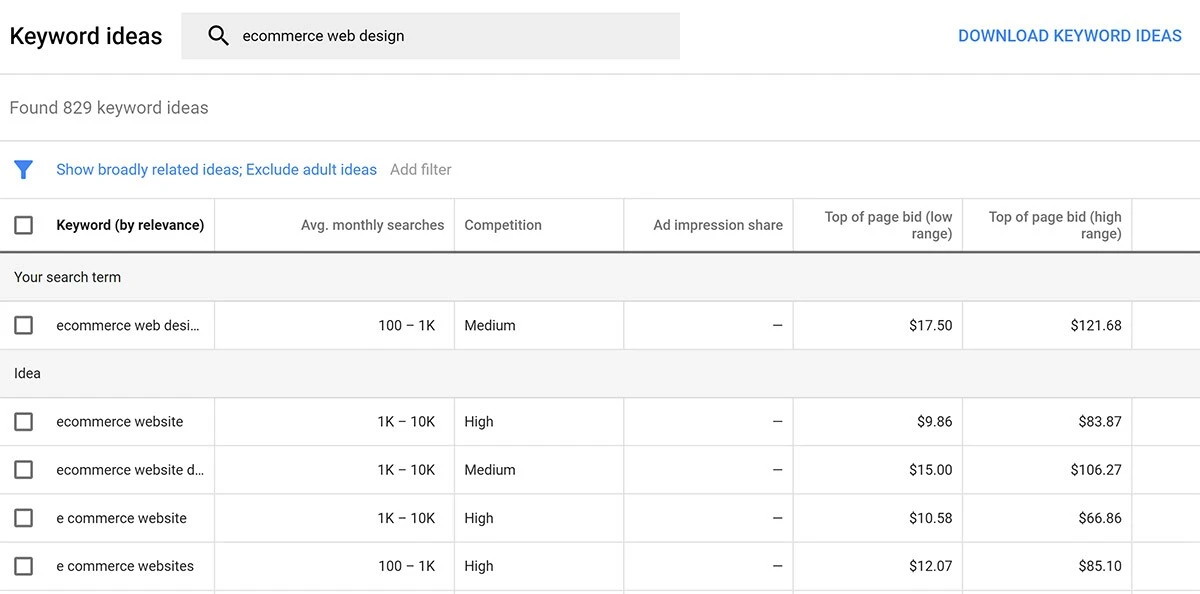
Google Keyword Planner can help you estimate part of the media budget. It shows keyword ideas, monthly search estimates, and average cost estimates for showing ads on searches. But Google also warns that performance depends on bid, budget, ad quality, location targeting, product, industry behavior, and other factors. Treat forecasts as a starting point for budget planning, not a guarantee.
PPC Management Pricing Models
There is no single correct pricing model. The right structure depends on account size, complexity, goals, and how much execution the agency owns.
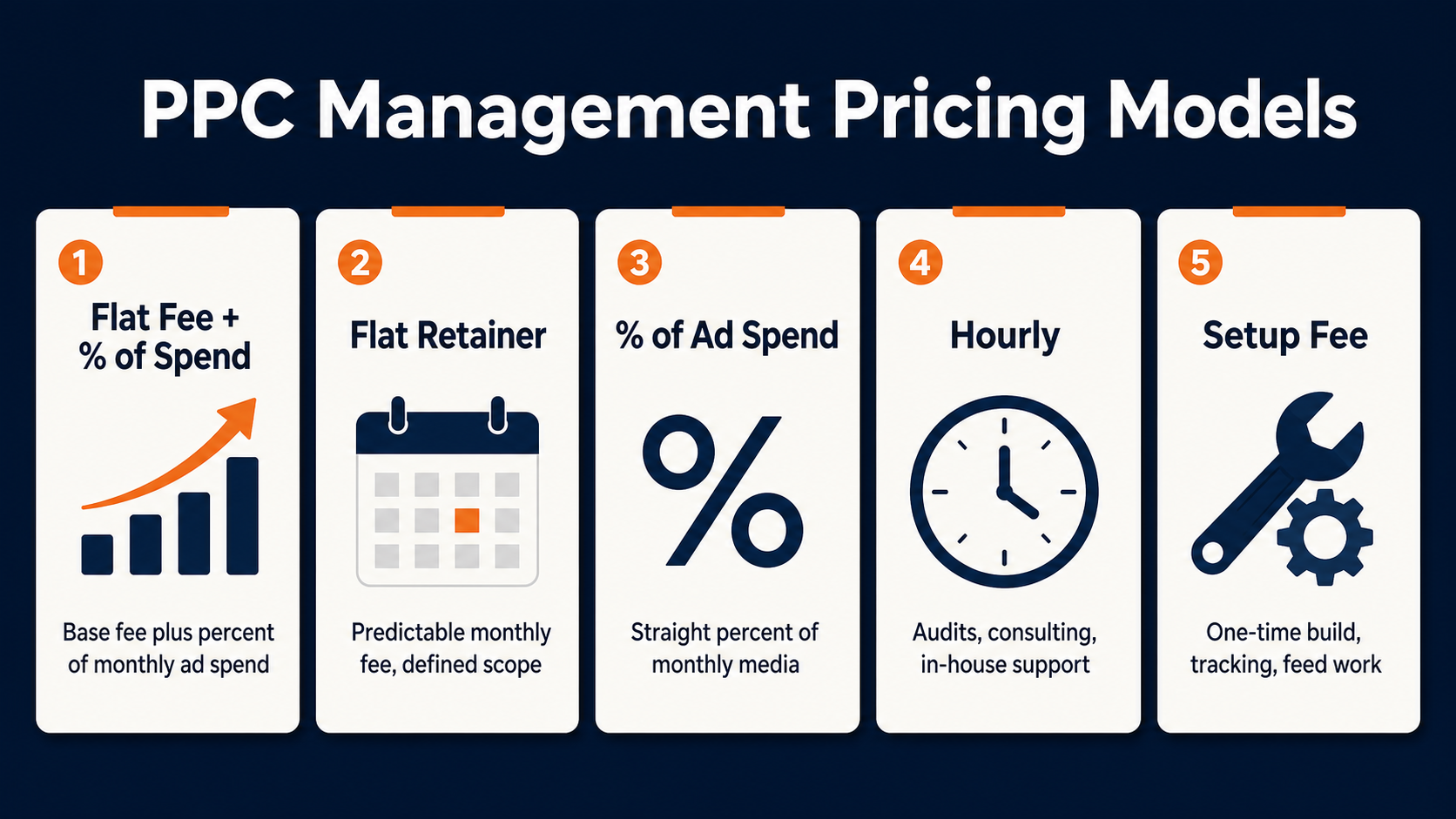
Flat Monthly Fee Plus Percentage of Spend
Flat monthly fee plus a percentage of ad spend is still one of the most common PPC management pricing models. The fixed fee covers the baseline work required each month: account reviews, search term analysis, reporting, tracking checks, meetings, and optimization. The percentage component scales as spend and complexity increase.
This model can be fair when the account truly needs more work as spend grows. A $75,000 monthly budget may involve more campaigns, more landing pages, more data, more reporting, and higher risk than a $5,000 account.
The guardrail is incentive alignment. The agency should be able to explain how it protects efficiency when spend increases. If the only answer is “spend more because we earn more,” the pricing model is working against you.
Flat Monthly Retainer
A flat retainer gives both sides a predictable number. It works well when scope is clear: one or two platforms, defined reporting cadence, stable campaign count, and a known level of testing.
Flat fees are common for smaller accounts and for agencies that want to avoid the perceived conflict of charging a percentage of spend. The risk is under-scoping. A flat fee that sounds low may exclude work you assumed was included, such as conversion tracking QA, feed review, landing page feedback, call tracking, or reporting beyond a monthly summary.
Percentage of Ad Spend
Some agencies charge a straight percentage of monthly ad spend. A 15% fee on $20,000 in monthly media would equal a $3,000 management fee.
This model is easy to understand and can work when campaign complexity grows with spend. It becomes weaker when spend grows but the workload does not, or when the agency has no performance accountability. Large accounts often negotiate lower percentages, tiered percentages, or hybrid retainers because the labor does not always scale in a straight line.
Hourly Rate or PPC Consulting
Hourly pricing is usually a better fit for audits, training, cleanup projects, in-house team support, and strategy work than for full ongoing management. Current PPC consulting or specialist rates often fall around $75 to $250+ per hour, depending on experience, geography, and scope.
Hourly can be useful when you need a senior review without handing over daily execution. If you need a roadmap, a second opinion, tracking cleanup, or help deciding whether to move into management, Google Ads consulting may be the better starting point.
Setup Fees
Setup fees are normal when there is real setup work. New account builds, campaign restructuring, tracking audits, GA4 conversion work, enhanced conversions, call tracking, CRM imports, Shopping feed cleanup, landing page recommendations, and reporting setup all take time before ongoing optimization begins.
The setup fee should be tied to a concrete deliverable. Ask what will exist when setup is complete: campaign structure, conversion actions, tags, dashboards, feed fixes, creative assets, or a written strategy.
Performance-Based or “No-Fee” Models
Be careful with “free” PPC management. The agency still has to make money. Sometimes that money comes from software commissions, media markups, low-touch automation, bundled services, or limited reporting access.
Performance-based pricing can also be risky if the definition of performance is weak. A contract that rewards raw lead volume may encourage low-quality leads. A contract that rewards revenue without clear attribution may create disputes. A serious performance model needs clean tracking, agreed attribution rules, lead-quality definitions, and visibility into the full funnel.
What Should Be Included in a PPC Management Fee?
The management fee should cover the work that makes media spend accountable. If an agency quote does not make these items clear, ask before signing.
- Account audit and strategy. Review the current structure, goals, budget, search terms, landing pages, conversion setup, and reporting before changes begin.
- Keyword research and query control. Build keyword themes, match types, negative keyword lists, and search term review habits that protect the budget.
- Campaign structure. Separate brand and non-brand where needed, group campaigns by intent, and keep budgets readable.
- Conversion tracking. Review Google Ads conversion actions, GA4, enhanced conversions, call tracking, and offline conversion imports when leads close after the form fill.
- Ad copy and asset testing. Test responsive search ads, extensions, images, calls to action, and offer angles.
- Shopping and feed management. For ecommerce, product titles, feed attributes, Merchant Center health, ecommerce PPC planning, and Google Shopping campaign management often affect performance as much as bids do.
- Performance Max guardrails. Performance Max can reach Search, YouTube, Display, Discover, Gmail, and Maps from one goal-based campaign, which makes goals, feeds, exclusions, audience signals, and reporting review important.
- Landing page feedback. A weak post-click experience can make good traffic look bad. Paid media and conversion rate optimization should inform each other.
- Budget pacing and bid management. Manage daily budgets, bid strategies, seasonality, and spend allocation by return signal.
- Reporting and recommendations. Reports should explain CPL, CPA, ROAS, revenue, lead quality, and what changes next.
This is why cheap PPC management often gets expensive. The missing work does not disappear. It shows up later as wasted clicks, bad tracking, unclear reports, and slower decisions.
What Changes the Price?
PPC management costs rise when the account has more places to leak budget or more data that needs interpretation.
| Price driver | Why it affects cost |
|---|---|
| Ad spend level | Higher spend usually creates more risk, more data, and more budget-allocation decisions. |
| Number of platforms | Google, Microsoft, Meta, LinkedIn, Amazon, and YouTube all require different controls. |
| Campaign mix | Search, Shopping, Performance Max, Display, Video, and retargeting do not manage the same way. |
| Business model | Ecommerce needs revenue, ROAS, feed, and margin context. Lead gen needs lead quality, CRM, calls, and pipeline context. |
| Product catalog size | More SKUs mean more feed work, product grouping, Merchant Center health, and Shopping/PMax decisions. |
| Industry competition | Legal, home services, finance, healthcare, B2B software, and other high-CPC markets leave less room for waste. |
| Tracking complexity | GA4, enhanced conversions, call tracking, offline imports, and CRM attribution change the scope. |
| Landing page needs | If the page does not match the ad or convert traffic, management has to account for the post-click problem. |
| Reporting cadence | Weekly strategy calls, executive dashboards, and revenue reporting take more time than a monthly export. |
| Rebuild urgency | A messy inherited account may need a deeper rebuild before normal optimization starts. |
The cleanest quote is the one that shows which of these factors are actually in scope.
Which PPC Management Pricing Model Does OuterBox Use?
OuterBox does not force every account into a one-size-fits-all package. Before quoting, we review your website, current PPC account, tracking, competitive landscape, industry, and goals. If the fit is not right, we would rather say so than sell a package that cannot support the outcome.
Many OuterBox PPC clients use a flat fee plus percentage of spend model, but the final structure depends on what the account needs. A small local account, a national lead-generation campaign, an ecommerce Shopping program, and a multi-platform paid media plan do not require the same team rhythm.
That scoping process also looks beyond paid media. PPC and SEO work best together. PPC can create immediate visibility while SEO builds durable organic traffic, and the two channels often make better budget decisions when they are read side by side. If a paid search campaign is covering a term while SEO gains ground, the budget conversation is different from an account where paid ads are the only source of qualified traffic.
If you want a direct read on the account, start with Google Ads agency and management services or request a paid search estimate.
Local PPC Campaign Pricing vs. National Campaigns
Local and national PPC campaigns do not scope the same way.
A local campaign may have a smaller geography, fewer keyword groups, fewer landing pages, and a tighter service area. That can reduce management complexity and media spend. It can also make testing slower if the market is small and conversion volume is limited.
National campaigns usually have a larger keyword universe, more competitors, more segmentation, and more budget allocation decisions. They may need separate campaigns by region, product, service, funnel stage, or audience. That adds management time.
Local does not always mean cheap, though. A personal injury firm, HVAC company, roofing company, or healthcare provider in a competitive metro can face high CPCs and strict lead-quality needs. A low management fee is not useful if the campaign spends on irrelevant searches or reports every form fill as equal.
The useful question is not simply “local or national?” It is: how many markets, services, campaigns, landing pages, calls, forms, and qualified lead types need to be managed?
PPC Management Pricing vs. ROI
PPC management can feel expensive because the management fee sits beside the media spend. The right question is not whether the fee feels high in isolation. The question is whether total PPC investment can produce profitable customers.
Use this simple framework:
Total monthly PPC investment = ad spend + management fee + setup/tools/landing page costs
Then evaluate that against:
- Cost per lead or cost per acquisition.
- Lead quality and close rate.
- Average order value or deal value.
- Gross margin.
- Customer lifetime value.
- Sales cycle length.
- Revenue or pipeline attributed to the campaigns.
- Return on ad spend where ecommerce revenue is tracked.
If you spend $1 and reliably make $5 in gross revenue, paid search can be worth scaling. If you spend $1 and make $1.10 before labor, fulfillment, or overhead, the campaign may still be unprofitable. The management fee has to be judged in that full model.
Good management can pay for itself by reducing wasted spend, improving conversion tracking, tightening search terms, raising conversion rate, and shifting budget toward campaigns that produce qualified demand. But no agency should promise that every account can scale instantly or that a fee will automatically return a fixed multiple.
Retargeting and Remarketing Costs
Retargeting, or remarketing, reaches people who already interacted with your website, ads, products, or brand. It can bring visitors back after they compare options, abandon a form, leave a cart, or need more proof before converting.
Retargeting usually costs less per click than high-intent search, but the budget depends on audience size, frequency, creative needs, funnel stage, and platform. Many advertisers start by planning roughly 5% to 20% of media spend for remarketing, then adjust once audience size and performance data are clear.
The goal is not to chase people forever. The goal is to reinforce the decision with relevant proof: product reminders, case studies, service comparisons, financing, promotions, trust signals, or a better next step. Retargeting works best as part of a holistic PPC management program, not as a disconnected side campaign.
Warning Signs in Cheap PPC Management
Low fees are not automatically bad. Small accounts can have simple needs. The warning sign is a low fee paired with no explanation of what work is actually being done.
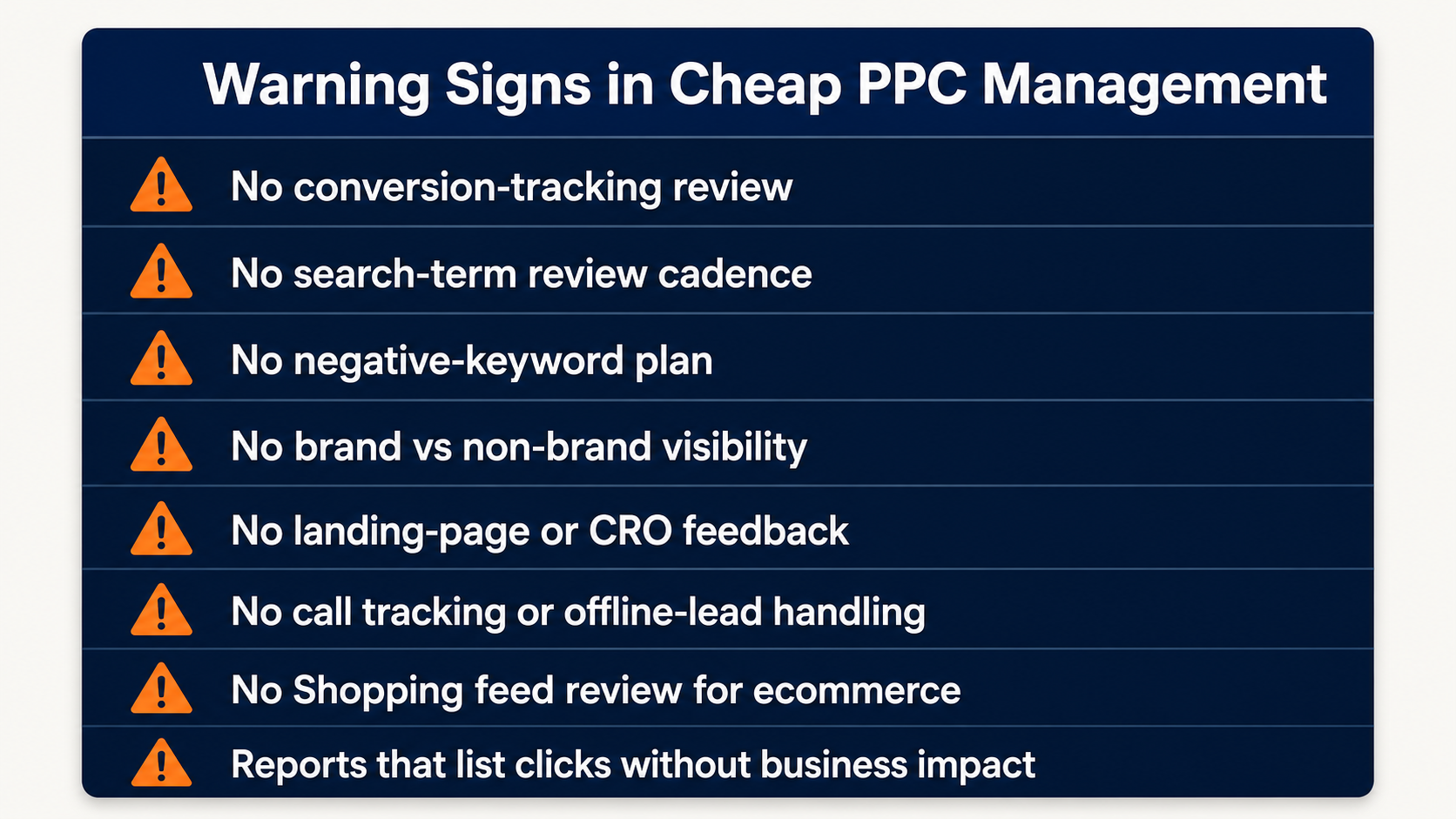
Be cautious if a PPC management proposal includes:
- No conversion-tracking review.
- No search term review cadence.
- No negative keyword plan.
- No brand vs. non-brand visibility.
- No landing page or CRO feedback.
- No call tracking or offline lead handling when phone or sales-team follow-up matters.
- No Shopping feed review for ecommerce accounts.
- No Performance Max guardrails.
- No visibility into actual platform spend.
- Reporting that lists clicks and impressions without explaining business impact.
- A “set it and forget it” automation pitch.
The fee should buy better decisions: cleaner tracking, tighter campaign structure, stronger query control, less wasted spend, and reporting that helps you decide what to spend next.
Advantages of Choosing OuterBox to Manage Your PPC Campaign
OuterBox is a Premier Google Partner with 20+ years of paid search management experience and $105M+ in Google Ads spend managed across client campaigns. Our team manages Search, Shopping, Performance Max, Display, and YouTube with reporting tied to qualified leads, revenue, CPL, and ROAS.
The difference is that PPC does not live by itself here. Paid media performance often depends on analytics, landing pages, feed quality, CRO, SEO, design, and development. OuterBox has those teams in-house, which means the account manager is not stuck diagnosing a landing page, tracking, or feed problem with no way to fix it.
When you work with OuterBox, you can expect:
- A personalized estimate based on account, website, tracking, industry, and goal review.
- Certified paid media specialists across Google Ads and broader PPC channels.
- Campaign structure built around business outcomes, not vanity metrics.
- Monthly performance reporting and strategic recommendations.
- Ecommerce, B2B, and lead-generation experience, with analytics and Google Analytics consulting support when tracking is limiting performance.
- CRO and landing page support when traffic quality is strong but conversion rate is weak, plus a clear path from audit to ongoing management if management is the right next step.
Still Have Questions About PPC Pricing?
The most useful PPC quote starts with your account, website, tracking, industry, competitors, and growth goals. A serious agency should be able to explain what fee model it recommends, what work is included, where your media budget goes, and how the program will be judged.
If you want a clearer read on your Google Ads or paid search budget, request a paid search estimate. OuterBox will review the opportunity, explain the likely management scope, and help you decide whether ongoing management, consulting, or a narrower audit is the right next step.
PPC Management Pricing FAQs
How much does PPC management cost per month?
Many PPC management engagements fall between $1,500 and $5,000 per month, but smaller accounts can be lower and complex multi-channel programs can exceed $10,000 to $25,000 per month. The fee depends on ad spend, campaign complexity, tracking, channel mix, reporting, and business model.
What percentage of ad spend do PPC agencies charge?
Many PPC agencies charge around 10% to 20% of monthly ad spend, often with a minimum fee. Larger accounts may use tiered percentages or a hybrid retainer because the work does not always scale exactly with spend.
Is the Google Ads management fee separate from ad spend?
Yes. Ad spend is the money paid to Google for media. The management fee is what you pay the agency or consultant for strategy, setup, optimization, testing, tracking, and reporting.
Is a setup fee normal for PPC management?
Yes, if the setup fee is tied to real work. Campaign builds, tracking cleanup, GA4 and Google Ads conversion setup, enhanced conversions, call tracking, Shopping feed review, and reporting dashboards can all require one-time setup before monthly management begins.
Is flat-fee or percentage-of-spend pricing better?
Neither model is always better. Flat fees are predictable. Percentage-of-spend models can scale with account complexity. Hybrid models can work when the base fee covers minimum work and the percentage scales with budget. The important question is whether the fee matches the work and incentives.
How much should a small business spend on Google Ads?
Small businesses often start with a few thousand dollars per month in media spend, but the right number depends on CPCs, geography, conversion rate, lead value, margin, and sales goals. Use Keyword Planner and your own conversion math to estimate whether the budget can generate enough data and qualified demand.
What does PPC management include?
PPC management should include strategy, campaign setup, keyword research, search term reviews, negative keywords, ad testing, bid and budget management, conversion tracking, reporting, and landing page feedback. Ecommerce accounts may also need Shopping feed and Merchant Center work.
How much does PPC consulting cost?
PPC consulting is often billed hourly or as a scoped audit. Rates commonly vary by experience and scope, but many senior consultants and agencies fall in the $75 to $250+ per hour range. Consulting is usually best for audits, strategy, training, and in-house team support rather than full day-to-day management.
Are cheap PPC management services worth it?
Sometimes, if the account is small and the scope is clear. Cheap PPC management becomes risky when it excludes tracking QA, search term reviews, negative keywords, landing page analysis, and meaningful reporting. A low fee can cost more if it lets wasted spend continue.
How much should I spend on retargeting?
Many advertisers start with about 5% to 20% of media spend for retargeting, then adjust based on audience size, frequency, creative, and conversion data. Retargeting should support the broader PPC strategy, not run as an isolated campaign.
Is AdWords the same as Google Ads management?
Google AdWords was the old name for Google’s advertising platform. The current name is Google Ads, but many people still search for AdWords management fees or AdWords management pricing when they mean Google Ads management.